Recently I gave color another shot for several days. It’s okay, looks pretty good, there’s nothing wrong with it. But to me something vital is lacking in my color shots and I realize that black and white is my language. (I prefer to call it black and white rather than monochrome or grayscale. Old school I guess).
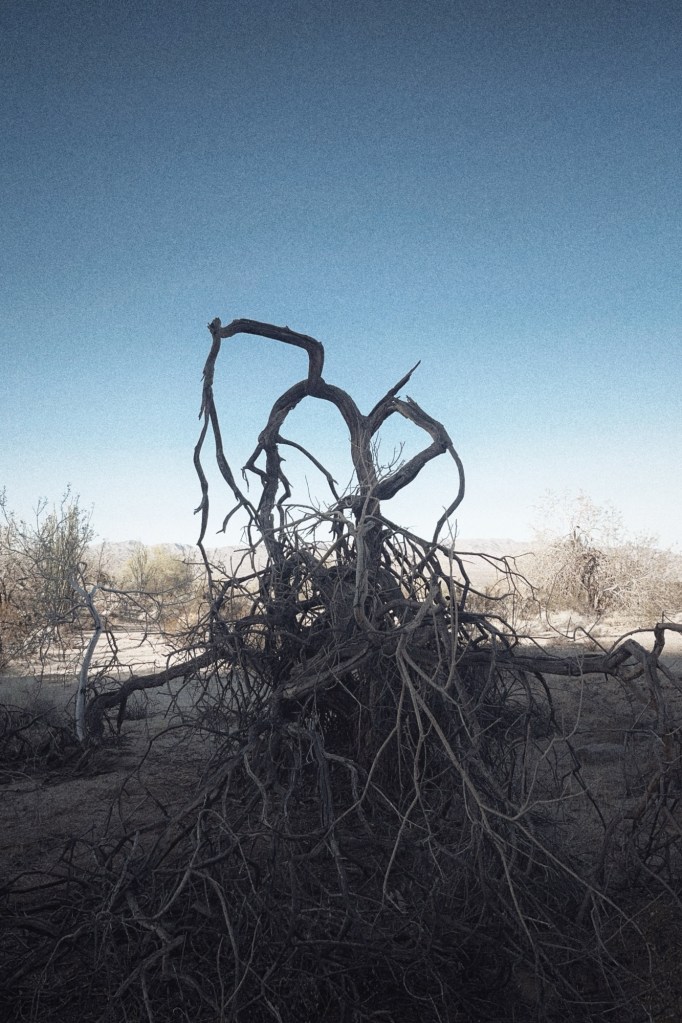
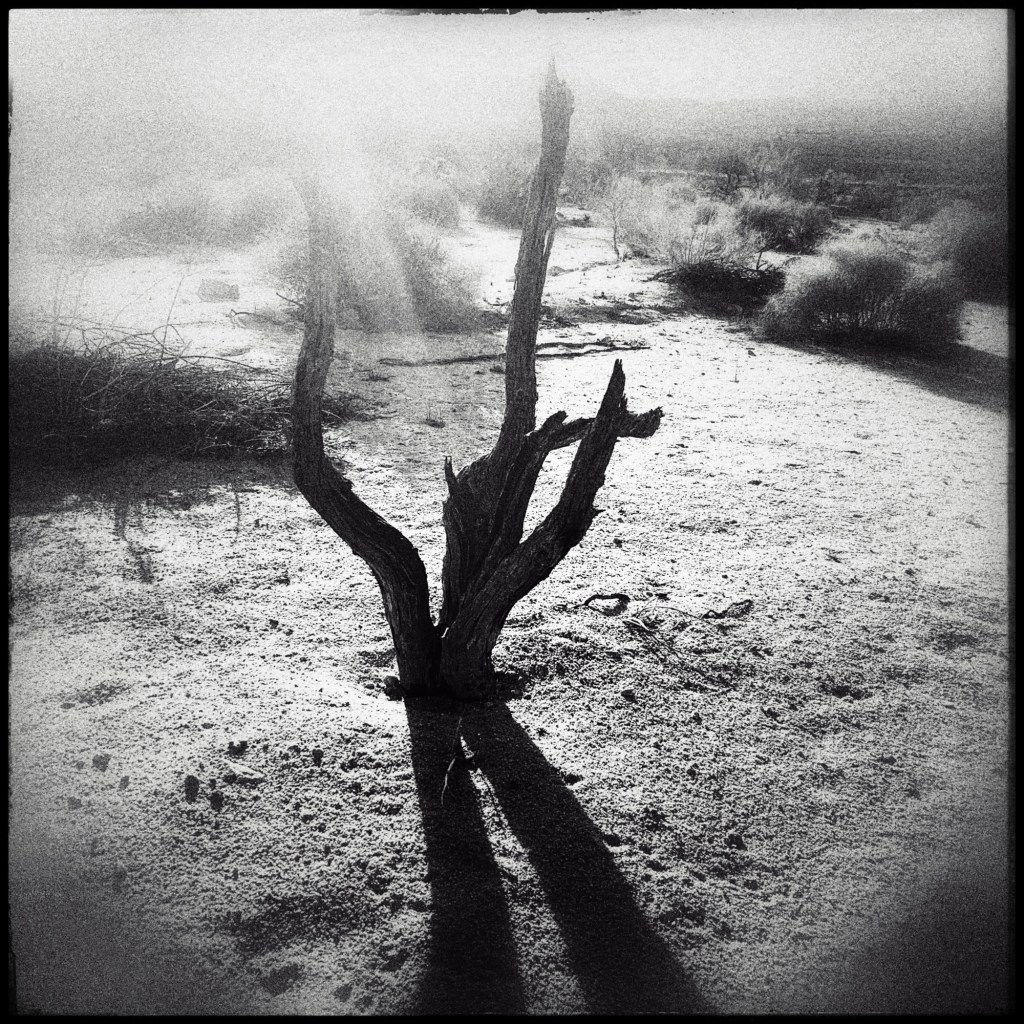
Why? Let’s say you sat a scientist, maybe a biologist or botanist, down in front of a dead desert ironwood alongside someone like Jim Harrison and asked each to write a short paragraph or poem about it. From the scientist you’d likely get an accurate description. Literal. Scientific. Factual. A scientific fact. But probably pretty dry. From Harrison you’d get a poem. An expression of soul. Of feeling. Of spirit and mystery. To me this is the big difference between color and black and white. Fact vs. feeling.
For me a worthwhile photo points to what Robert Adams called a mystery greater than our failures. Color, at least in my hands, is factual, doesn’t point to that mystery. It doesn’t have that feeling, that soul. It’s too literal. It falls short. Black and white can if done well. That, the doing it well, is the challenge.
I seldom shoot color. It’s not that I don’t like it, I do, but I’m rarely satisfied with the results I get. I don’t often like what I do with it. I’ve gotten so used to doing b/w that my color seems weak, that it doesn’t have the bite of b/w, and it doesn’t. But maybe it doesn’t need to. It has it’s own qualities.
I want to add more color to what I do, so I’m gonna challenge myself to work with it for awhile to see if I can make it work. For how long? Who knows – maybe a few days. Maybe a few weeks. We’ll see. Maybe I’ll decide that no, it’s not my medium. Maybe I’ll learn to like it. Only one way to find out. Stay tuned.
‘I have advice. Keep your eyes open.’ – Robert Frank.
‘f/8 and be there.’ – Robert Capa
There’s some of the best photography advice I’ve ever heard. Keep your eyes open and be there. Your pictures are all around you. Not anybody elses. Yours.
Don’t do the ten-thousandth imitation of what we’ve all seen a million times. They’ve been done to death. Yours are there. Photos that are unique to you. Photos only you could take. Open your eyes and find them.
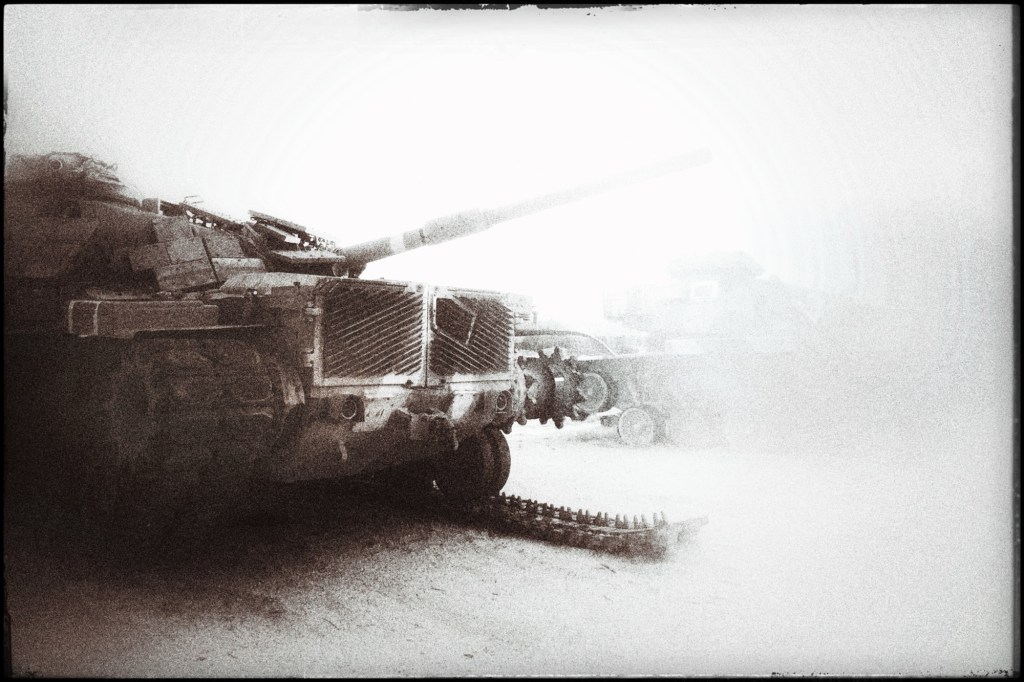
I take a lot of pictures of these tanks. And of flags and crosses and madonnas. I’m neither religious nor a flag worshipper, but to me they are powerful symbols of our society and culture.
I’ve always liked photography with a lo-fi look and feel. Lo-fi, lomography, toy camera photography – call it what you will. It has a certain funkiness, a kind of soul and guts to it that’s the antithesis of the almost sterile perfection of most digital photography. It has character.
If I was to return to film photography I think I’d opt for something like a Holga. It’s not gonna happen, but still… I use my phone these days. A basic iPhone 13 – none of the unnecessary pro or pro max shit. The basic model suits me just fine and it slides nicely into my pocket. I don’t use the native camera, I use a couple of other b/w apps with tap screen shutters. The freedom and flexibility and spontaneity they give me is priceless. A few tweaks in Snapseed will give me as lo-fi a look as I want. Or not. I can blow out the contrast and exposure, I can shoot at any angle, I can add grain (which I usually do) and blur when I want. All with a few moves with my fingertip. I generally find that if I have to spend more than about two minutes adjusting an image that shot failed and I shitcan it. That pretty well sums up my equipment and method. Enough said.
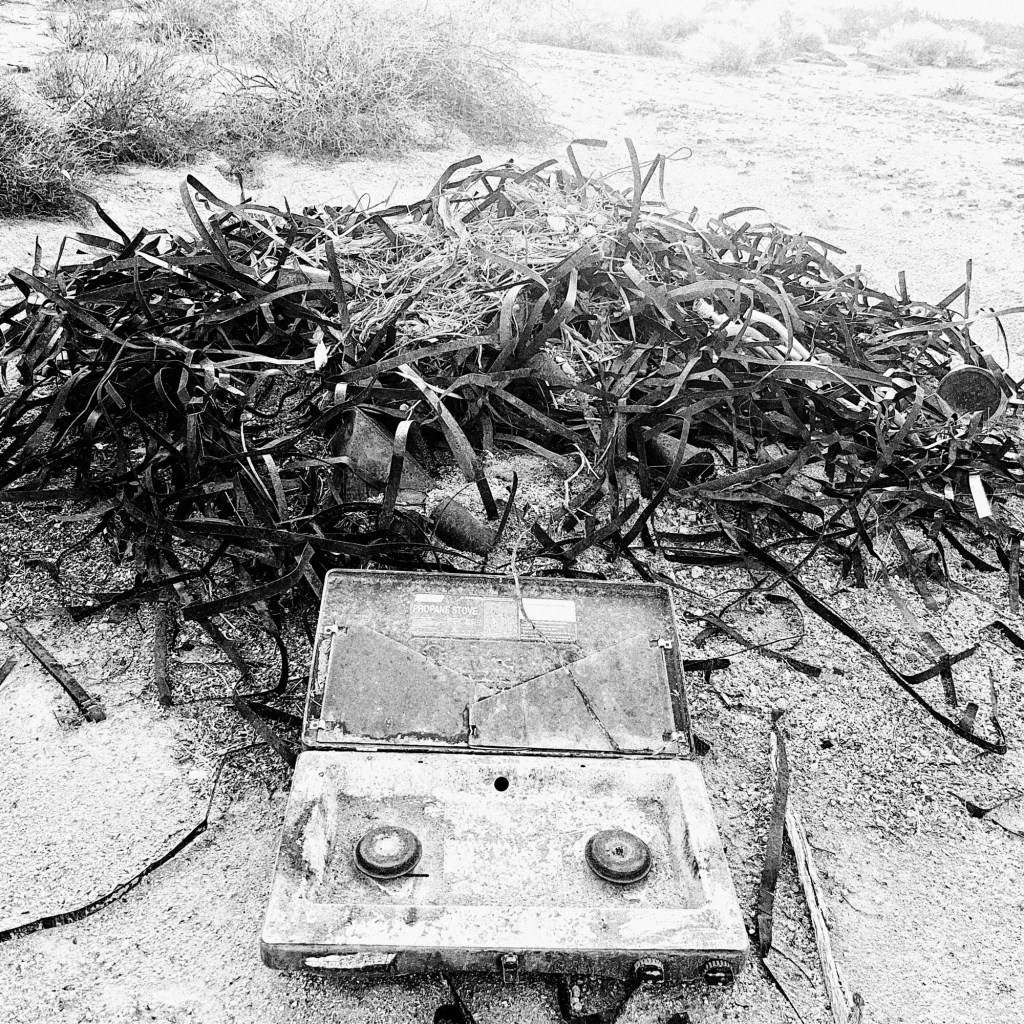
What’s most important to me is to convey a sense of the mystery and underlying spirit of the desert. It’s a rough-edged powerful place. A woozy, grainy, sun-blasted look suits it – an almost mirage like feel, a vibe like you’ve been out in the desert sun too long. That’s what it’s like out here. It’s a rough grainy place where the sun dominates. To my mind a rough grainy lo-fi look gets that across much stronger than a clinical, technically perfect photo can even come close to.
Back in the ’30s Ansel Adams, Edward Weston, and a few others formed a group to break away from the painterly pictorialist photography prevalent at the time. Group f64. You’ve heard of it. Bold and innovative at the time. Adams subsequently lapsed into formula and became a print factory, largely due to Bill Turnage, the business manager he hired. Weston stayed true to his vision for the rest of his life. Others weren’t as well known.
The Group f64 aesthetic became the standard for much of the photography that followed. For decades the sharp edge to edge focus, the rules of composition and exposure became set in stone and became the conventional criteria for what was considered good photography, and many photographers still slavishly follow them. Especially in nature and landscape photography. Technical proficiency and the willingness to follow accepted rules has become paramount. The result? Millions of pictures made every day that basically look the same, that fit the accepted definition of good. That have no individuality or soul. There are of course exceptions.
I started taking pictures seriously in the mid-70s. I’ve pretty much run the gamut of equipment – 4×5 which I abandoned almost as soon as I tried it, 120 TLR which I used quite a bit, and a lot of 35mm. These days, since coming out to the desert I use my phone. It suits me.
I made a crippling decision back then – I thought photography would be a great way to make a living. I followed all the standard advice. Study the markets, give the buyers what they want and need. Study the best then do it your own way – but still follow the rules. I had minimal success. I wasn’t anywhere near as good as the best, and I certainly didn’t have anything remotely unique or original. I wasted many years doing this and then quit taking photos for most of the ’90s. Looking back I consider most of that as not a waste. Just practice.
Since coming out here to the desert I’ve started to find my own voice, my own way of working. That can be good, but it can also be a trap. Stay on the same path and it can become a rut. My style (as much as I detest that word) isn’t likely to change much, but I think it’s good to try a different path now and then to see where it goes. More often than not it’s a dead end, but you can discover something new and interesting on it. I’ll try different approaches – double exposures, maybe a touch of grunge now and then, things like that, and if they work I’ll use them. If they don’t I’ll cheerfully shitcan them.
Above all, if I can send the pedantic ones, the conventional ones, the rule followers, if I can send them into convulsions I’ll be on the right track. I’ve got a long way to go, but I’m working on it. Cheers.

 desert topographics